
By @genjustlaw
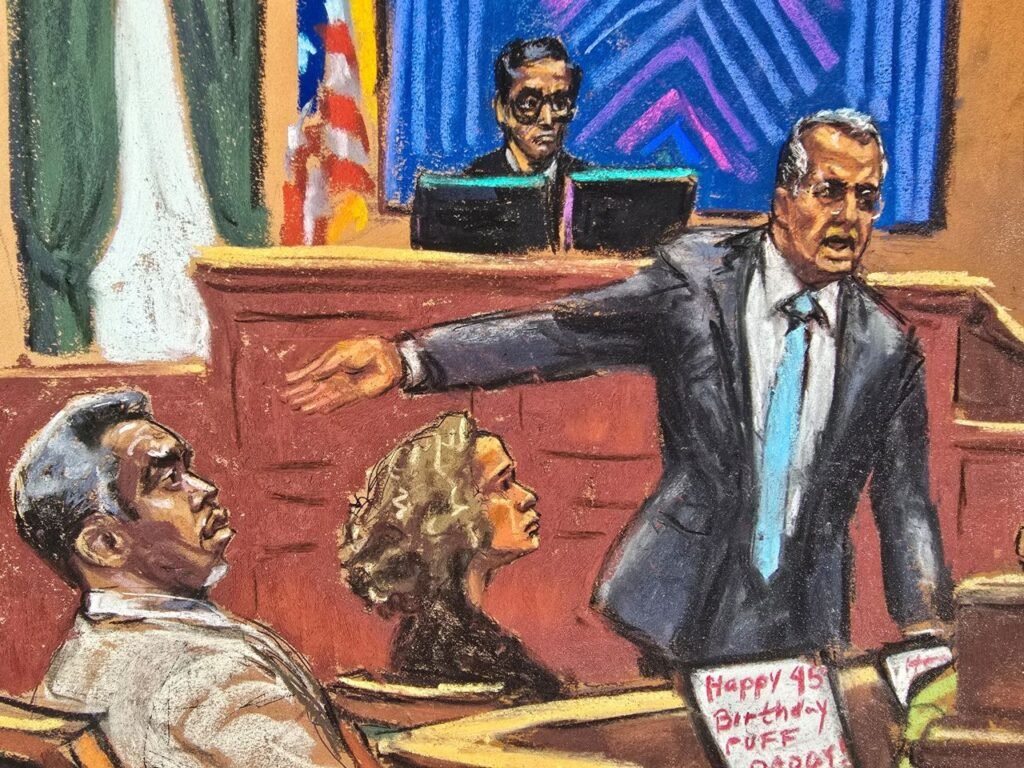
New York, June 27 — In the final moments before the jury deliberates, defense attorney Marc Agnifilo offered a closing argument that was both bold and methodical.
Representing Sean “Diddy” Combs against federal charges including sex trafficking and racketeering, Agnifilo steered clear of outright denials. Instead, he delivered a sharp legal dissection of what the law requires and what the government failed to prove.
Reframing the Narrative
Agnifilo opened by contrasting two visions of the trial: one grounded in “evidence texts, witnesses, and video” and another crafted, in his words, “through the mouths of the prosecutors.” This rhetorical move aimed to draw a line between lifestyle and liability.
According to Agnifilo, the government’s portrayal blurred morally provocative behavior with criminal conduct.
The defense conceded that Combs lived unconventionally and may have engaged in consensual group sex and funded escort services. But Agnifilo insisted that this does not amount to sex trafficking under the law.
Parsing the Statute: What Is Sex Trafficking?
Under federal law, sex trafficking requires more than sexual activity, it requires force, fraud, or coercion used to obtain a commercial sex act. Agnifilo’s argument rested on that threshold. He suggested the prosecution failed to prove that Combs used illegal means to obtain sex from others, especially when the alleged victims maintained ongoing romantic or financial relationships with him.
One example: the defense pointed out that “Jane,” one of Combs’ accusers, was still living in a Combs-paid residence and receiving support. That, according to Agnifilo, undermines any claim of ongoing coercion.
Moreover, he asked the jury to consider the ambiguity of escort services like “Cowboys for Angels,” which provided men for the so-called “Freak Offs.” “Why is he supposed to know more than them, if they’re in business and sending escorts?” Agnifilo asked, arguing that Combs believed he was paying for time, not for sex.
Taking on the RICO Allegation
The defense also took aim at the RICO charge, one of the most serious in the indictment. Agnifilo highlighted that no co-conspirators were indicted. The government had suggested that Combs’ chief of staff and head of security were involved, but Agnifilo used their perceived loyalty to the alleged victim, Cassie Ventura, to show they weren’t blindly following Combs.
“If this was a conspiracy, why did she call them for help?” he asked.
Without direct testimony from an insider claiming a criminal enterprise existed—or evidence that any of Combs’ employees knowingly furthered illegal acts—the RICO charge becomes significantly harder to prove.
Moral Shock vs Legal Standard
Agnifilo’s final appeal to the jury was not emotional but constitutional. “At what point do you stop trusting the government?” he asked, attacking prosecutorial overreach.
He acknowledged Combs’ flaws—calling out episodes of domestic violence—but drew a sharp line between abuse and trafficking. “Being a domestic abuser is not the same as being a sex trafficker,” the defense implied, echoing a distinction even the prosecution tried to blur in rebuttal.
The Verdict Ahead
The case against Combs is complicated not by its facts, but by the tension between lifestyle and law. Agnifilo’s closing argument tried to cut through that tension with statutory clarity: What the public may find reprehensible is not necessarily illegal.
Whether the jury sees things the same way may now hinge on their reading of coercion, intent, and what truly defines an “enterprise.”
Author

Latest entries
 Lex Feminae Index2026-01-29Kenya 🇰🇪 | A Legal System That Acknowledges Violence But Fails to Stop It
 Lex Feminae Index2026-01-27Climate-Driven Displacement: The Jurisdictional Black Hole For GBV Survivors
 Lex Feminae Index2026-01-16Why Access To Justice Determines GBV Outcomes in Climate Crises
 Lex Feminae Index2025-12-1016 Days |Online Abuse Is Gender-Based Violence. The Law Must Catch Up