
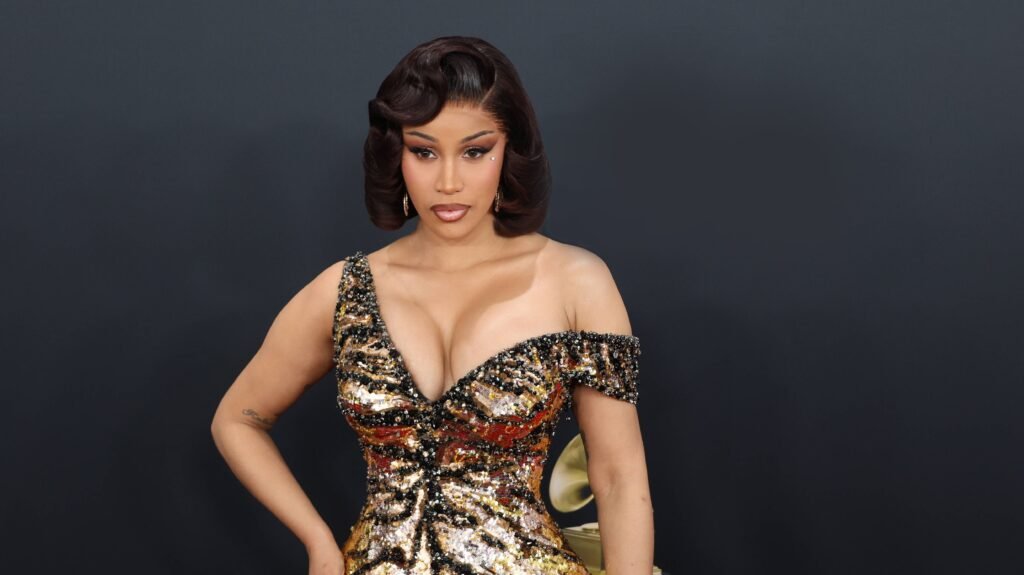
The first day of Cardi B’s civil assault trial opened with sharp testimony from plaintiff Emani Ellis, a former Beverly Hills security guard. Ellis alleged that during a confidential OB-GYN appointment in February 2018, Cardi B approached her aggressively, spat in her face, cursed at her, and scratched her cheek with a three-inch fingernail. Ellis described the incident as deeply traumatizing and said she believed the rapper confronted her because she thought Ellis was recording video on her phone.
Defense attorney Peter Anderson countered that narrative by portraying Ellis as the aggressor. He told jurors that Cardi B, pregnant at the time, had every reason to be protective of her privacy and safety. According to his account, Ellis was a large, imposing figure who allegedly stepped toward Cardi B, hovered over her, and threatened, “I will fuck your shit up.” Anderson said staff had to pull Ellis away, while Cardi acted only out of fear for her unborn child.
Under cross-examination, Ellis’s testimony came under scrutiny. In her initial incident report, filed two days later, she wrote that she was on her phone checking voicemail because of a sick parent. In court, she denied using her phone that day. The report also described scratches to her nose, while she testified in court that her cheek was injured. When pressed on the inconsistency, Ellis claimed both areas were affected in different ways.
The plaintiff originally alleged that Cardi B also used her celebrity influence to have her fired from her job, but that claim has since been dropped, leaving only the assault allegations for the jury to consider. Because this is a civil case, the standard of proof is “preponderance of the evidence,” meaning Ellis must only show it is more likely than not that Cardi B assaulted her. This is significantly lower than the “beyond a reasonable doubt” standard required in criminal trials, which means the defense has less margin for error in dismantling her story.
Cardi B is expected to take the stand later this week, giving jurors a rare opportunity to hear directly from a celebrity defendant. For Cardi B, this case is not about potential jail time but about reputation, damages, and how the law balances the privacy of public figures with accountability when those figures are accused of crossing a line.
Author

Latest entries
 Lex Feminae Index2026-01-29Kenya 🇰🇪 | A Legal System That Acknowledges Violence But Fails to Stop It
 Lex Feminae Index2026-01-27Climate-Driven Displacement: The Jurisdictional Black Hole For GBV Survivors
 Lex Feminae Index2026-01-16Why Access To Justice Determines GBV Outcomes in Climate Crises
 Lex Feminae Index2025-12-1016 Days |Online Abuse Is Gender-Based Violence. The Law Must Catch Up