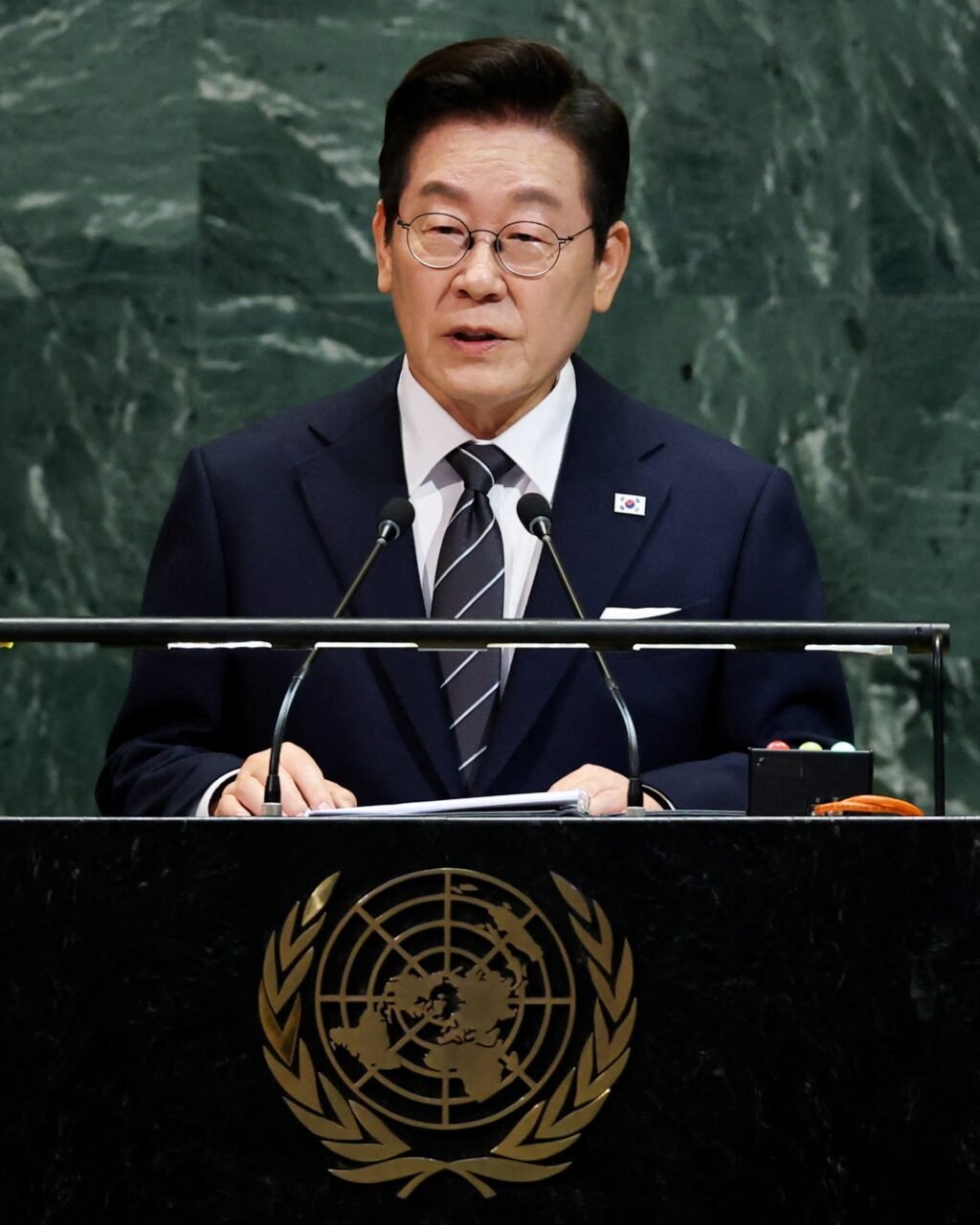
New York, USA — In the grand hall of the United Nations General Assembly on September 23, 2025, South Korean President Lee Jae-myung took the podium for the 80th session, delivering a speech that wove Korea’s post-war miracle into a broader plea for global solidarity amid escalating conflicts from Ukraine to Gaza.
Titled “Return to Democracy,” his address opened with gratitude to UN leaders like President Annalena Baerbock and Secretary-General António Guterres, framing the organization’s 80-year legacy as an “unfinished task” embodied by South Korea’s own improbable rise from devastation to prosperity.
Yet, even as delegates nodded to his optimistic vision of inter-Korean economic ties paving the way for denuclearization, the room buzzed with undercurrents of skepticism, as Lee’s words, calling for gradual cross-border cooperation to foster peace on the peninsula, clashed sharply with accusations of naivety and hypocrisy echoing from critics back home and abroad.
At its core, the speech highlighted South Korea’s evolution as a testament to UN ideals, with Lee asserting that his nation’s history of overcoming division and authoritarianism proves multilateralism’s power to heal war-torn societies. He urged incremental steps toward North-South collaboration, suggesting economic exchanges could build trust and ultimately dismantle Pyongyang’s nuclear arsenal, while pledging Seoul’s continued contributions to UN peacekeeping missions worldwide.
However, this forward-looking rhetoric quickly drew fire for its perceived detachment from reality; North Korean state media swiftly dismissed it as a “hypocritical ploy” from a leader whose past as Gyeonggi Province governor allegedly involved skirting UN sanctions through unauthorized business dealings with Pyongyang, including a reported $8 million infusion to a North Korean firm in violation of international resolutions.
Legally, such claims, stemming from ongoing probes by South Korea’s prosecution service, raise thorny questions under the UN Security Council’s Resolution 1718 and subsequent measures, which prohibit economic aid that could bolster the regime’s weapons programs; if substantiated, Lee’s pre-presidency actions could expose him to diplomatic isolation or even calls for UN accountability, though his administration counters that these were legitimate provincial initiatives frozen under stricter federal oversight.
Transitioning seamlessly from peninsula-specific appeals to global imperatives, Lee decried the “ceaseless” failures in upholding international peace, invoking Korea’s democratic struggles as a blueprint for addressing authoritarian resurgence elsewhere. He positioned South Korea not just as a beneficiary of UN aid but as a proactive middle power, ready to mediate in hotspots like the Middle East and Eastern Europe through pragmatic diplomacy that balances alliances with adversaries.
Nevertheless, this multilateral ethos masked deeper tensions in Lee’s foreign policy pivot, particularly his subtle overtures to China, omitting direct criticism of Beijing’s Taiwan encroachments while emphasizing “inclusive growth,” which analysts interpret as a recalibration away from the hawkish U.S.-centric stance of his predecessor.
Politically, this risks eroding the ironclad U.S.-ROK Mutual Defense Treaty framework, as evidenced by Lee’s recent CSIS remarks questioning over-reliance on American troops as a “submissive mindset,” potentially inviting legal scrutiny under alliance protocols that mandate coordinated threat responses; conservative lawmakers in Seoul have already filed motions to investigate whether such statements undermine national security statutes, arguing they embolden adversaries like China at a time when U.S. tariffs loom large.
Moreover, Lee’s emphasis on sustainable development as inseparable from peace, citing Korea’s green energy transitions and aid to developing nations, served as a rallying cry for UN reform, yet it fell flat amid charges of domestic double standards.
Back in Seoul, his approval ratings hover below 40 percent, battered by scandals including alleged purges of judicial figures probing his finances and a crackdown on anti-China protests that free-speech advocates decry as violations of Korea’s 1987 Constitution.
Critiques lambasted the speech as a “recycled liberal fantasy,” with one viral thread accusing Lee of hypocrisy for preaching democracy while his party allegedly funnels resources to suppress church-led dissent, echoing broader legal debates over Article 20’s religious freedoms.
Internationally, U.S. think tanks like CSIS praised the alliance-upgrade nods but warned that Lee’s “pragmatic” China tilt could trigger bilateral frictions, potentially invoking dispute mechanisms in the KORUS FTA if economic concessions to Beijing disadvantage American interests.
As applause faded in the UN chamber, Lee’s address lingered not for its soaring prose but for the fault lines it exposed in South Korea’s global posture, where bold visions of reconciliation collide with unresolved legal shadows and partisan rifts.
While supporters hail it as a pragmatic reset for a divided peninsula, detractors, from Pyongyang propagandists to Seoul’s opposition benches, see a leader out of touch, whose words may fortify rhetoric abroad but falter under the weight of accountability at home.
In an era of fraying multilateralism, the true test lies not in the speech’s echoes but in whether Lee’s unfinished democratic task can withstand the scrutiny it inevitably provokes.
Author

Latest entries
 Lex Feminae Index2026-01-29Kenya 🇰🇪 | A Legal System That Acknowledges Violence But Fails to Stop It
 Lex Feminae Index2026-01-27Climate-Driven Displacement: The Jurisdictional Black Hole For GBV Survivors
 Lex Feminae Index2026-01-16Why Access To Justice Determines GBV Outcomes in Climate Crises
 Lex Feminae Index2025-12-1016 Days |Online Abuse Is Gender-Based Violence. The Law Must Catch Up