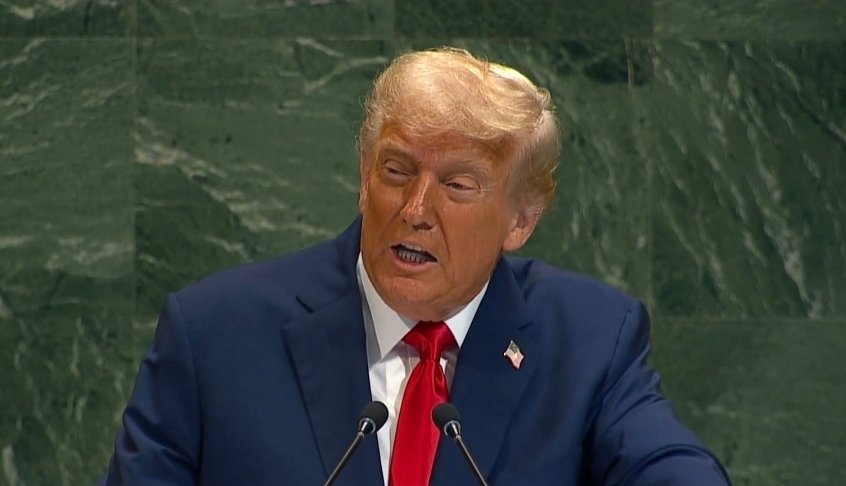
New York, USA — President Donald Trump used his address at the 80th United Nations General Assembly to launch a fierce critique of the institution itself, dismissing climate change as a “hoax” and arguing that the UN has failed to support the United States in key global disputes. His speech drew instant scrutiny and underscored the deep divide between nationalist politics and the multilateral system the UN was created to uphold.
Trump charged that the UN had “not helped him” when the United States pressed for tougher stances on trade and international conflicts, casting the body as little more than a talking shop. Legal experts note that this argument misstates how the UN Charter functions. Enforcement powers lie primarily with the Security Council, where the United States holds a permanent veto. When Washington does not achieve consensus, it is often the U.S. position itself that blocks further action.
On climate, Trump’s denunciation of global warming as a hoax puts him at odds with both scientific consensus and binding international frameworks. The 2015 Paris Agreement, while not imposing strict emissions quotas, obliges signatories to submit nationally determined contributions and report progress. By rejecting this structure, Trump weakens not only U.S. credibility but also the broader principle that climate change is a matter of international law and shared obligation.
Politically, the address reinforced Trump’s long-standing “America First” narrative, presenting U.S. sovereignty as incompatible with what he portrays as UN overreach. Yet the United States is bound by the UN Charter, a treaty ratified by Congress in 1945, which commits the nation to collective security and international cooperation. Withdrawal or defiance would carry both legal and geopolitical costs.
Diplomats in the chamber may have heard familiar themes, but Trump’s speech raises sharper questions. When the sitting president of the United States dismisses the UN’s authority, it undermines the credibility of the rules-based order at a moment of global crisis. For the UN on its 80th anniversary, the message was not one of cooperation, but a challenge to the very foundations of multilateralism.
Author

Latest entries
 Lex Feminae Index2026-01-29Kenya 🇰🇪 | A Legal System That Acknowledges Violence But Fails to Stop It
 Lex Feminae Index2026-01-27Climate-Driven Displacement: The Jurisdictional Black Hole For GBV Survivors
 Lex Feminae Index2026-01-16Why Access To Justice Determines GBV Outcomes in Climate Crises
 Lex Feminae Index2025-12-1016 Days |Online Abuse Is Gender-Based Violence. The Law Must Catch Up