Eighty years. Nine men. Zero women. That is the United Nations’ record on leadership.
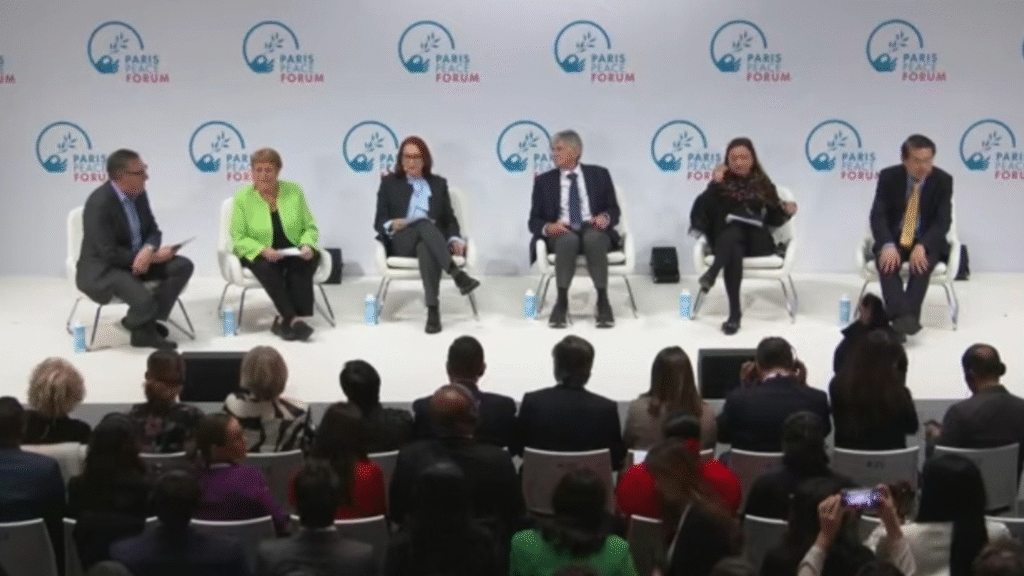
At the Paris Peace Forum this week, the conversation about reform turned into something bolder representation.
It’s been eighty years. Eight decades of men sitting at the helm of the world’s most visible institution for peace and justice. Every Secretary-General since 1945 has carried the same profile: male, diplomatic, cautious to the point of paralysis. The United Nations has survived wars, genocides, pandemics, and irrelevance, yet its leadership remains trapped in the same demographic echo chamber. So why not a woman?
This is not a slogan or a symbolic demand. It is a question of justice and functionality. As Maria Fernanda Espinosa put it at the Paris Peace Forum, it is “not only a matter of democratic justice but of quality of leadership.” The United Nations speaks endlessly about inclusion, yet fails to embody it at the top. The irony is suffocating.
Michelle Bachelet, who has led both a country and the UN’s human rights office, framed the stakes clearly: peace without justice is an illusion. Justice without representation is hypocrisy. Women are not waiting to be included. They are already leading the institutions that define modern governance. The European Central Bank, the World Trade Organization, and the International Monetary Fund all have women at the top. The UN, somehow, is still catching up.
United Nations
Former High Commissioner for Human Rights
United Nations; Former President, Republic of
Chile
There is also a practical argument. Women leaders tend to focus on the connective tissue of governance: fairness, trust, human security. At a time when the world is being fractured by authoritarian populism and ecological collapse, that human-centered approach is not soft power. It is the only power that still works.
Critics will argue that the position is symbolic, that the Secretary-General serves at the mercy of the Security Council, which remains a five-nation oligarchy. But symbolism is not trivial. The face of the UN sets its moral tone. A woman Secretary-General would signal to billions that the institution is finally ready to represent the world as it is, not as it was drawn in 1945.
There are plenty of qualified women ready to take on the job: Bachelet herself, Espinosa, Mia Mottley of Barbados, or Ngozi Okonjo-Iweala of the WTO. Each brings diplomatic experience, independence, and global respect. The problem is not talent. It is tradition.
Center for China and Globalization
Founder and President. Center for China and
Globalization (CCG)
A female Secretary-General would not fix the UN overnight. But she could force it to look in the mirror, to confront the gap between its principles and its practices. She could restore credibility to a system that has forgotten how to inspire.
Eighty years in, the question is no longer whether the UN is ready for a woman. The question is what excuse it has left not to have one.
If the UN cannot embody equality at its highest level, it cannot preach it anywhere else.

Author

Latest entries
 Lex Feminae Index2026-01-29Kenya 🇰🇪 | A Legal System That Acknowledges Violence But Fails to Stop It
 Lex Feminae Index2026-01-27Climate-Driven Displacement: The Jurisdictional Black Hole For GBV Survivors
 Lex Feminae Index2026-01-16Why Access To Justice Determines GBV Outcomes in Climate Crises
 Lex Feminae Index2025-12-1016 Days |Online Abuse Is Gender-Based Violence. The Law Must Catch Up