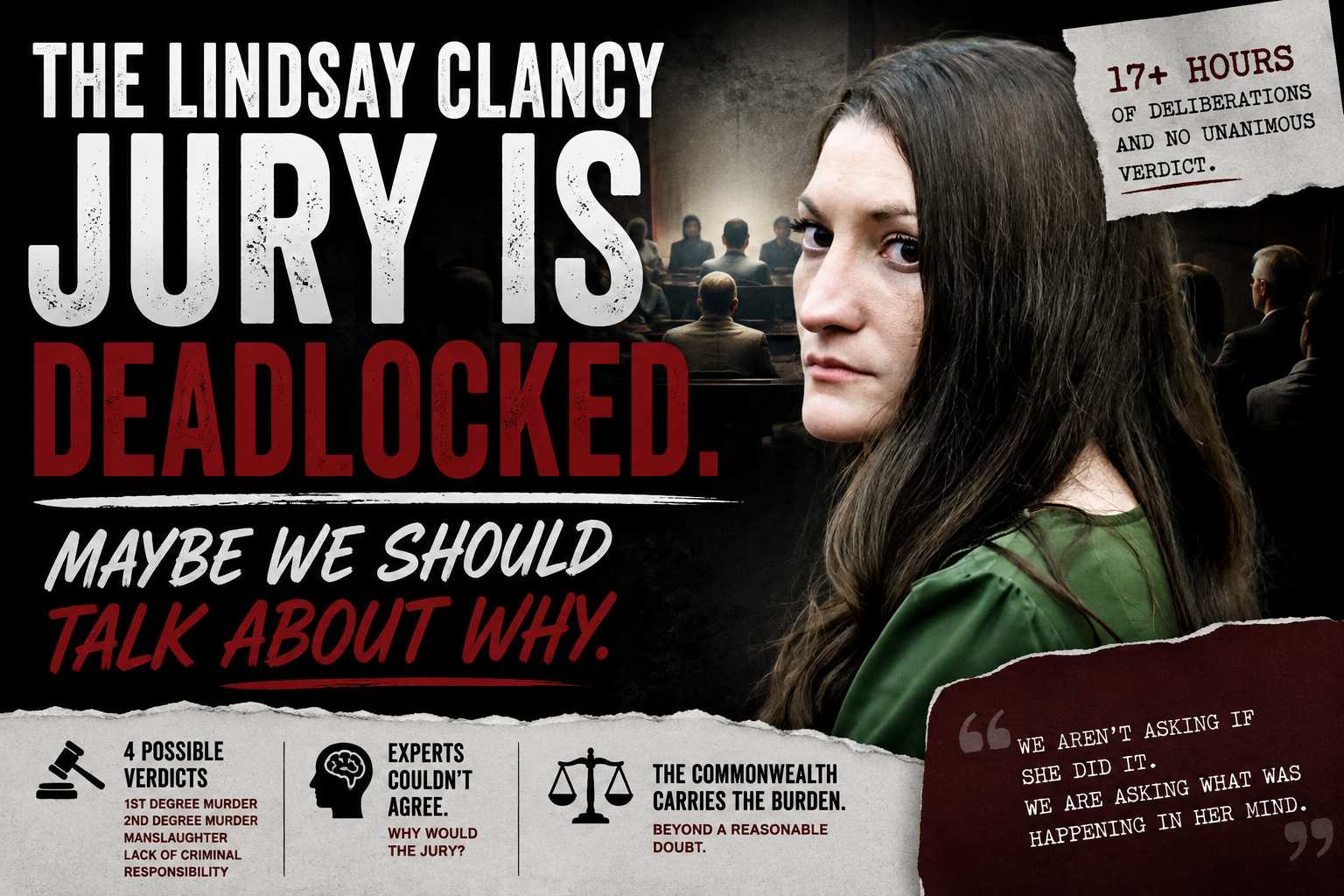
So, the Lindsay Clancy jury is deadlocked.
After more than 17 hours of deliberations, they told the judge they could not reach a unanimous decision.
And I have to say, I am not surprised.
Not because I think I know what the verdict should be. Not because a long deliberation automatically favors Lindsay Clancy. And definitely not because a deadlock tells us how many jurors are sitting on either side of this case.
We know none of that.
But after watching this trial, I think the fact that twelve people are struggling to agree makes perfect sense.
Because what exactly are we asking them to agree on?
We are not asking them whether Lindsay Clancy killed her children.
That is not disputed.
We are asking them to decide what was happening inside her mind when she did it.
More importantly, we are asking them to decide whether the Commonwealth proved beyond a reasonable doubt that she was criminally responsible when she did it.
Those are very different questions.
And somewhere along the way, I think the public discussion about this case lost sight of that.
This Was Never Really About Whether Lindsay Was Mentally Ill
One of the strangest things about watching the debate around this trial has been seeing people argue about whether Lindsay Clancy was mentally ill.
That is barely the dispute.
Even prosecution experts acknowledged significant mental illness.
The real disagreement is over what that mental illness meant at the exact time she killed Cora, Dawson and Callan.
Did she understand what she was doing?
Could she appreciate that it was wrong?
Was she acting through depression and suicidality while still understanding the nature and wrongfulness of her actions?
Or had her mental illness crossed the line into psychosis to such a degree that she could no longer appreciate that wrongfulness?
That is where the prosecution and defense separated.
And that distinction is everything.
You can be severely mentally ill and still be criminally responsible.
You can have a psychiatric diagnosis and still be criminally responsible.
You can behave irrationally and still be criminally responsible.
The legal question is much narrower.
And the Commonwealth carries the burden.
Once lack of criminal responsibility is properly raised, Lindsay Clancy does not have to prove her insanity to the jury. The prosecution has to prove beyond a reasonable doubt that she was criminally responsible.
That changes how we should look at this deadlock.
The Experts Could Not Agree Either
This is probably the biggest reason I am not shocked by what is happening in that jury room.
Look at the expert testimony.
Dr. Phillip Resnick looked at Lindsay Clancy and concluded that she was psychotic and not criminally responsible.
Dr. Paul Zeizel reached a similar conclusion regarding her ability to appreciate the wrongfulness of what she was doing.
Then the prosecution brought its experts.
Dr. Avram Mack agreed that Lindsay was mentally ill, but concluded that she remained capable of understanding and controlling her actions.
Dr. Kirk Heilbrun also concluded that she was criminally responsible.
Dr. Gregory Saathoff questioned parts of Lindsay’s account, including the alleged command hallucination.
These are not random people arguing on Facebook.
These are professionals who reviewed records, interviewed Lindsay, considered her history and testified under oath.
And they did not agree.
That does not mean the jury should simply throw up its hands and say, “Well, the doctors couldn’t figure it out.”
Jurors still have a job to do.
But it does illustrate the problem.
If trained forensic experts can examine the same woman, the same medical history, the same killings and the same surrounding circumstances and reach fundamentally different conclusions about her mental state, why are we surprised that twelve jurors might do the same?
And Then There Is the Command Hallucination
This may be one of the hardest pieces of the case for the jury.
Lindsay said she heard a voice telling her to kill the children and herself.
The defense says that fits with psychosis.
The prosecution says there are reasons not to believe it.
And there are legitimate questions.
Why had she apparently never experienced that kind of hallucination before?
Why did it apparently disappear afterward?
Why were there details in her later accounts that prosecutors believed were inconsistent?
Those are fair questions.
But here is where things get complicated again.
The psychological testing did not establish malingering.
That does not mean the command hallucination definitely happened.
It does not mean every statement Lindsay made was accurate.
And it certainly does not automatically establish lack of criminal responsibility.
But it matters.
Because there is a significant difference between saying, “I cannot prove this happened,” and saying, “I have proven she invented it.”
Those are not the same thing.
And when the Commonwealth has the burden beyond a reasonable doubt, that distinction becomes important.
The Prosecution Has Evidence Too
This is also why I do not think anyone should read the deadlock as some obvious defense victory.
The prosecution gave this jury plenty to work with.
They focused heavily on sequence.
Lindsay asked Patrick to leave the house.
She was alone with the children.
The children were taken to the basement.
Each child was strangled.
She then attempted suicide.
The Commonwealth wants the jury to see decisions.
One decision followed by another decision followed by another.
That is powerful because planning and purposeful behavior can support an inference that someone understood what she was doing.
But there is a problem with treating purposeful movement as the end of the analysis.
A psychotic person can perform actions.
A mentally ill person can make decisions.
Someone experiencing a delusion can behave methodically within the logic of that delusion.
So the fact that Lindsay completed a sequence of acts does not, by itself, answer the legal question.
The jury still has to determine what those actions tell them about her ability to appreciate wrongfulness.
And apparently, they do not all see that evidence the same way
The Jury Questions Were Interesting Too
Before announcing the deadlock, the jury asked to see the knife Lindsay used in her suicide attempt and the bags containing her prescription bottles.
I would love to know why.
We should not pretend we know.
Maybe they were reconstructing the timeline.
Maybe they were discussing medication.
Maybe they were examining her suicide attempt.
Maybe one juror wanted to verify a specific piece of testimony.
We simply do not know.
But those requests tell me something much more basic.
They are working.
They are going back into the evidence.
They are testing what they remember against what was actually introduced at trial.
And now they have told the judge that, after doing that work, they still cannot reach unanimity.
That is not a jury being lazy.
That is a jury struggling with the case it was given.
And No, Deadlocked Does Not Mean Mistrial. Yet.
This part matters because the word “deadlocked” immediately sends everyone to “mistrial.”
We are not there yet.
The jury told Judge William Sullivan that it could not reach a unanimous decision.
He sent them back to continue deliberating.
That is perfectly significant, but it is not the same thing as the court declaring that further deliberations are hopeless.
There are also multiple possible verdicts in play.
The jury is considering first-degree murder, second-degree murder, manslaughter and lack of criminal responsibility.
So when we say they cannot agree, we still do not know what they cannot agree about.
Maybe eleven people want one verdict and one person wants another.
Maybe it is six-six.
Maybe they agree Lindsay was criminally responsible but disagree about the degree of homicide.
Maybe the divide is criminal responsibility itself.
We have absolutely no idea.
And anyone confidently announcing the jury split right now is doing astrology with a verdict form.
But the Deadlock Does Tell Us Something
It tells us that at least one issue in this case is not obvious to all twelve jurors.
And I think that matters because this case has been discussed online for three years as though the answer should be obvious.
To some people, Lindsay Clancy is obviously a murderer who planned the deaths of her children.
To others, she is obviously a profoundly sick woman failed by the mental health system who had no understanding of what she was doing.
The evidence presented at trial was much messier than either of those narratives.
She sought psychiatric help.
She was hospitalized.
She was prescribed multiple medications.
There was substantial evidence of mental illness.
There was also evidence the prosecution says demonstrates planning, awareness and purposeful conduct.
Experts disagreed.
The lawyers disagreed.
The public certainly disagrees.
And now the jury disagrees.
Maybe that should not be treated as some shocking development.
Maybe it is the most predictable thing about this entire trial.
Because twelve people are being asked to look backward into another person’s mind on one horrific night in January 2023 and determine, beyond a reasonable doubt, whether she understood the wrongfulness of killing her children.
There is no blood test for that.
There is no brain scan from that exact moment.
There is no video showing us what Lindsay Clancy was thinking.
There is evidence.
There are experts.
There are medical records.
There are statements.
There are actions.
And then there are twelve human beings who have to decide what all of it means.
Right now, they cannot agree.
Maybe we should talk about why.

Leave a Reply