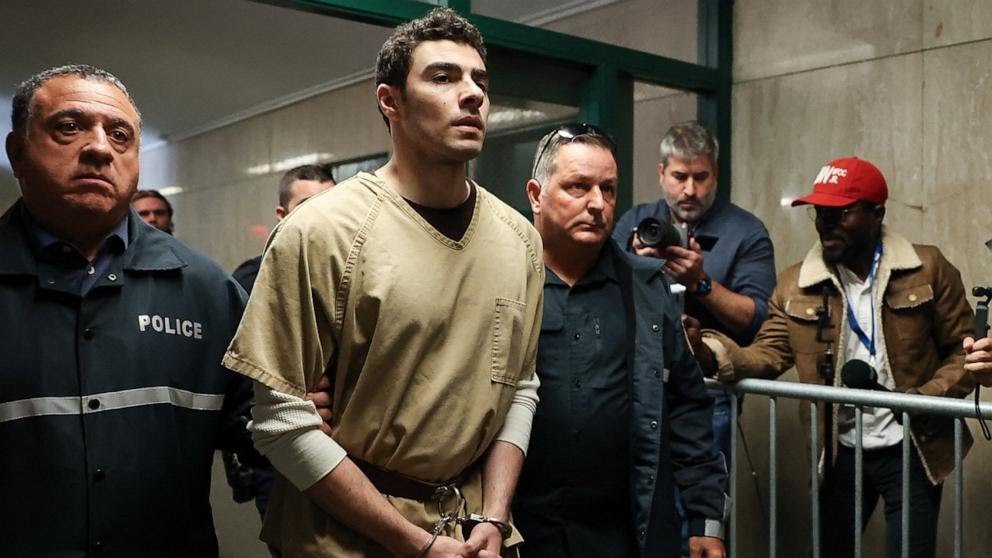
A New York judge has dismissed the most politically charged elements of the state’s case against Luigi Mangione, removing two terrorism-linked murder counts but leaving the core allegation intact. Justice Gregory Carro ruled prosecutors failed to establish that Mangione acted with the intent to intimidate a population or influence government policy, a statutory requirement for terrorism charges under New York law.
What remains is a straightforward but still formidable prosecution. Mangione continues to face a second-degree intentional murder count, along with weapons and forgery charges. The decision significantly narrows the scope of the state case, but it does not lessen the stakes for the defendant, who is simultaneously fighting for his life in federal court.
The defense had attempted to exploit the overlap between the two proceedings. Lawyers argued the state prosecution should pause until the federal trial concludes, raising claims of double jeopardy in the process. Judge Carro rejected both arguments, making clear that New York intends to move forward independent of the federal case. The next hearing in state court is now set for December 1.
The federal proceedings remain Mangione’s greatest legal risk. Prosecutors have charged him with murder through use of a firearm and stalking resulting in death. They have formally signaled their intent to pursue the death penalty, a rare step in federal practice and one that underscores the gravity with which the government views the allegations.
The legal posture highlights a divide between state and federal law. New York has abolished the death penalty and strictly limits the reach of terrorism statutes. Federal prosecutors, by contrast, retain broader charging authority and the option of capital punishment. Mangione’s fate will ultimately turn less on whether terrorism can be proven than on whether a jury is convinced beyond a reasonable doubt of his role in the killing.
For the defense, the dismissal of the terrorism counts is a small but tangible victory. It spares their client exposure to charges that carry heightened stigma and political resonance. Yet the larger battle remains unchanged. The state still has a murder case to try, and the federal government is preparing to test its capital indictment. The courtroom narrative has shifted, but Mangione is no closer to escaping the legal peril that now defines his future.

Leave a Reply