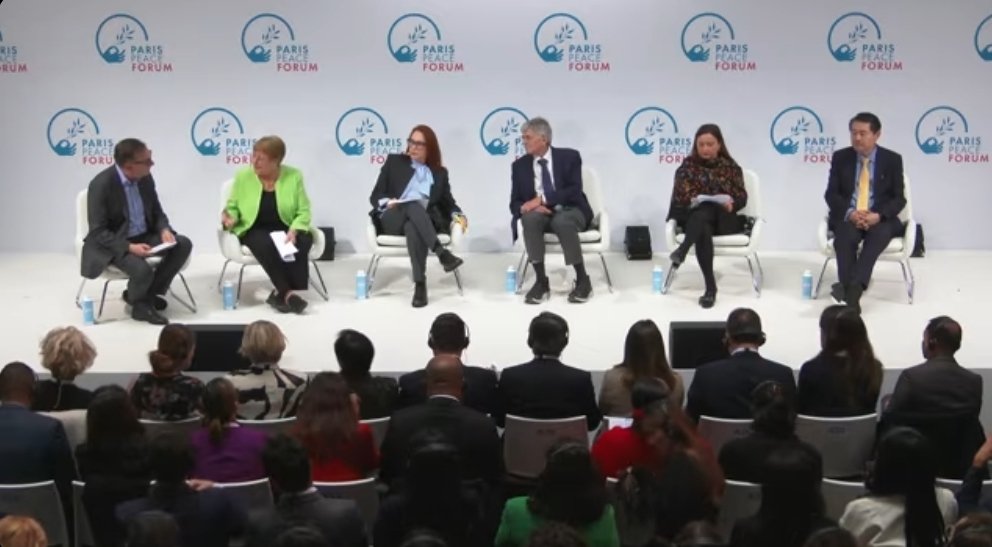
The United Nations turned 80 this year, and in Paris, the conversation about its survival sounded less like celebration and more like an intervention. The “UN at 80: From Mandates to Impact” session at the Paris Peace Forum gathered seasoned diplomats and institutional critics who shared a single message beneath diplomatic phrasing: the UN has become too crowded, too redundant, and too distant from the people it claims to serve.
Michelle Bachelet, former UN High Commissioner for Human Rights, opened the discussion with characteristic directness. She described a world where trust in multilateralism has eroded and where people no longer see the UN as a guarantor of dignity but as a distant bureaucracy. “Peace without justice is an illusion,” she said, calling for institutions that deliver fairness rather than promises. For Bachelet, peace is not only the absence of conflict but the presence of accountability and trust, built daily through inclusion and integrity.
Maria Fernanda Espinosa, Executive Director of GWL Voices and former President of the UN General Assembly, took the critique further. She described an organization drowning in meetings and resolutions while starving for results. “Twenty-seven thousand meetings a year, forty thousand resolutions, and eighty percent never reviewed,” she said, noting that the UN was “no longer responding to the people it was created to serve.” Her argument landed sharply: reform is not a slogan. It is survival. The UN 2.0 she envisions must be less about grand declarations and more about tangible outcomes.
Marjeta Jager of the European Commission agreed that reform cannot remain rhetorical. She pointed to what she called “the duplication problem,” with overlapping agencies and 50,000 separate mandates draining resources and purpose. Her solution was blunt: consolidation, not expansion. “We need to merge agencies and reinforce the core mandates,” she said, supporting the UN@80 initiative as a chance to turn the organization from a paper empire into an efficient system.
From the Global South, Henry Wang Huiyao, founder of the Center for China and Globalization, reminded the audience that legitimacy follows representation. He urged a Security Council expansion to include G20 members and African states, warning that “power must reflect reality or credibility will continue to erode.” His vision of a restructured council with checks on veto power drew applause from observers weary of the five-nation stranglehold that has long defined UN decision-making.
Jim Steinberg, dean of the Johns Hopkins School of Advanced International Studies, added a pragmatic note. Reform, he said, must match the world as it is, not the one imagined in 1945. He described a system where regional organizations now do the heavy lifting while the UN lags behind, “talking about coordination instead of doing it.” His call for clarity in roles and efficiency echoed across the hall.
The panel closed with a rare moment of unity around an old but overdue idea: the next Secretary-General should be a woman. Bachelet, Espinosa, and Wang all endorsed the notion without hesitation. Espinosa framed it as both justice and necessity. “Why not?” she asked. “After eighty years, it is time.” Steinberg added that a woman at the helm would bring back “a human face” to a system that often speaks in legalese instead of empathy.
By the end of the session, the UN’s 80th anniversary felt less like a milestone and more like a mirror. The institution that once embodied global cooperation now faces a crisis of purpose and credibility. Yet amid the frustration, there was also resolve. The speakers did not call for dismantling the UN but for rebuilding it from within. They spoke of merging agencies, modernizing mandates, and returning accountability to the heart of governance.
If the session had a verdict, it was simple. The UN does not need more mandates. It needs results. And after eighty years of resolutions and reports, the world is watching to see if it can finally deliver them.
Leave a Reply